
Introduction – 2026 World Predictions
As we step into 2026, the world stands at a crucial crossroads of transformation and consolidation. Planetary movements during this year signal shifts that extend beyond individual lives, influencing nations, economies, governance, and collective consciousness. Each year unfolds a new chapter in humanity’s journey, and 2026 carries themes of restructuring, accountability, and emerging global realignments.
Through the lens of mundane astrology, we can interpret how major planetary transits may reflect changes in natural phenomena, geopolitical dynamics, financial systems, and social structures. This article presents astrological insights into 2026, offering a cosmic perspective on how the year may shape key global events and the future direction of the world.
A Brief Recap of 2025
The year 2025 unfolded as a period of significant global shifts, reinforcing several themes highlighted in earlier astrological forecasts. On the political front, Donald Trump’s return to power as the 47th President of the United States marked a decisive turn toward economic nationalism. This was followed by increased tariffs on multiple countries, including India and China, impacting global trade flows, supply chains, and diplomatic relations. In South Asia, India–Pakistan relations worsened after the Pahalgam terror attack, reviving security concerns and geopolitical uncertainty in the region.
At the societal level, large-scale Gen Z–led protests, particularly in nations such as Nepal, signaled a generational pushback against existing systems and governance models. Environmental volatility dominated headlines as climate change intensified, bringing destructive cyclones such as Shakti, Montha, Senyar, Ditwah, and Hurricane Melisa, along with devastating floods across Sri Lanka, Indonesia, and Vietnam—developments that closely mirrored warnings issued in the 2025 global predictions. Technologically, 2025 stood out as a breakthrough year for artificial intelligence, with Agentic AI gaining practical adoption for autonomous, multi-step task execution, while Generative AI became mainstream for creating human-like content in response to prompts. Collectively, these events positioned 2025 as a year of geopolitical recalibration, environmental urgency, and rapid technological acceleration.
The Vedic New Year Chart for 2026
The Vedic New Year begins on the Amavasya (New Moon) of the Phalguna month. In 2026, this occurs on 19 March 2026 at 6:53 AM (IST), New Delhi, forming the foundational chart for assessing global trends.

The year opens under a highly charged planetary configuration, featuring a conjunction of Mars, retrograde Mercury, and Rahu, with additional aspects from Ketu and Jupiter. In classical Vedic astrology, the Mars–Rahu combination is associated with outbreaks of violence, mass unrest, and sudden crises, while a retrograde Mercury intensifies miscommunication, misinformation, and systemic vulnerabilities.
Varāhamihira, in Brihat Samhita, notes: “When Mercury moves in Vakra (retrograde) motion, conflicts and disturbances arise in the land.”
This planetary alignment suggests heightened geopolitical tensions, particularly among neighbouring states. Simultaneously, Mercury’s association with Rahu highlights accelerated technological evolution, especially in artificial intelligence and digital infrastructure. Traditional education systems may undergo rapid transformation as AI-driven learning models gain dominance. Since Mercury governs commerce and trade, global trade agreements, along with industries such as textiles, cotton, and garments, may face sustained challenges, regulatory pressures, and restructuring throughout the year. The Ministry of Commerce come under scrutiny.
Kalasarpa Configuration and Its Global Implications in 2026
The Vedic astrological framework for 2026 also draws attention to a Kalasarpa-like planetary configuration, wherein the majority of planets are positioned within the nodal axis of Rahu and Ketu. While it is true that Mercury lies marginally outside an exact conjunction with Rahu, leading some classical purists to debate the technical validity of a full Kalasarpa Yoga, the functional and experiential impact of this alignment cannot be overlooked. When all visible planets operate within the Rahu–Ketu axis, the psychological and material effects traditionally attributed to Kalasarpa Yoga are still strongly activated.
Classical texts clearly define this configuration. As stated in traditional literature:
“agre rāhuḥ ante ketuḥ sarve madhyagatā grahāḥ |
yogaṃ kālasarpākhyam nṛpa śasyavināśanam ||”
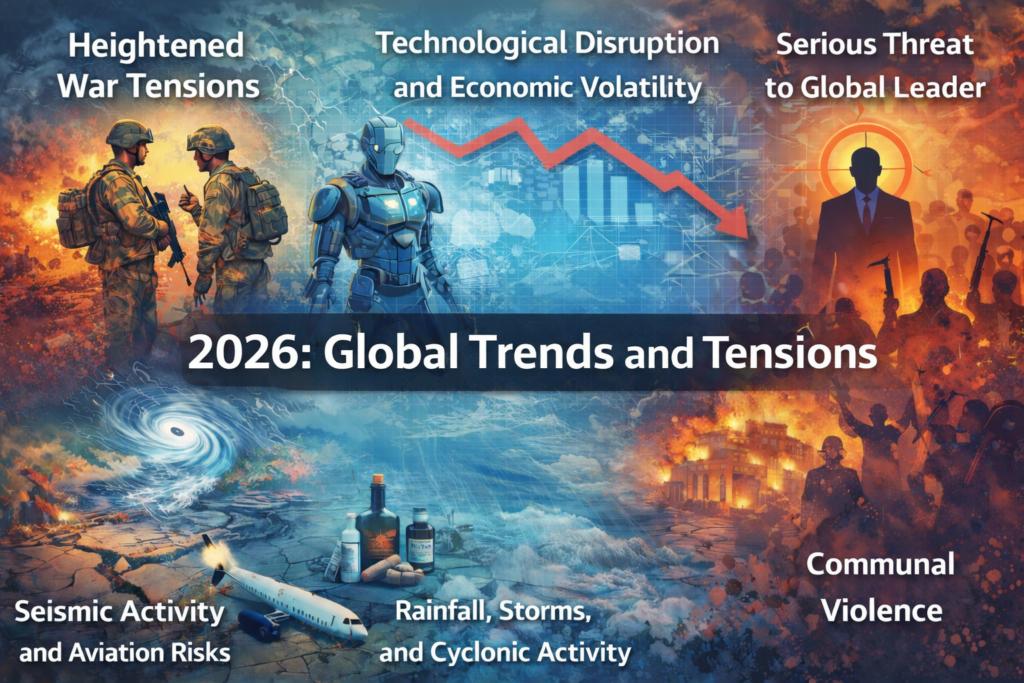
This verse explains that when Rahu leads, Ketu follows, and all other planets are confined between them, the resulting combination—known as Kalasarpa Yoga—is associated with the fall of rulers and destruction of crops. Interpreted in a modern global context, this symbolism aligns with the likelihood of heightened war tensions between bordering nations, damage to agricultural output due to extreme climatic events such as cyclones and flash floods, and a serious threat to the safety or stability of a prominent global leader.
Key Global Themes for 2026
Astrological indicators suggest a year marked by geopolitical strain, technological acceleration, environmental volatility, and heightened public safety concerns.
War and Geopolitical Tensions
The probability of communal unrest and military tensions remains elevated, particularly among bordering nations. These tensions are expected to peak in April 2026, when Mars and Saturn conjoin in Pisces, the 12th house of Kalapurusha, associated with losses, isolation, and foreign conflicts. Ongoing disputes involving India–Pakistan, India–China, Israel–Palestine, Russia–Ukraine, and China–Japan may intensify, contributing to global instability and diplomatic strain.
Technological Disruption and Economic Volatility
Artificial intelligence will continue to reshape economies, labor markets, and education systems. In 2026, AI-driven transformations may bring significant productivity gains, but also economic imbalances and speculative bubbles, particularly in sectors experiencing rapid automation and technological displacement.
Public Safety, Intoxicants, and Regulatory Risks
The Mars–Rahu–Mercury combination also raises concerns related to toxins, adulteration, and regulatory failures. There is a strong possibility of scams or malpractice within the liquor and intoxicant industries, potentially involving adulterated or unsafe products. In extreme cases, this may lead to serious health crises or loss of life due to contaminated alcoholic beverages, drawing attention to lapses in oversight, enforcement, and public safety mechanisms.
Rainfall, Storms, and Cyclonic Activity
While the year indicates overall healthy global rainfall, periods of intense cyclonic and storm activity are likely during April–May 2026, September–October 2026, and December 2026. Coastal and low-lying regions may face heightened vulnerability during these phases.
Seismic Activity and Aviation Risks
Planetary stress patterns suggest an increased likelihood of high-intensity earthquakes affecting North Africa, Indonesia, Japan, Russia, India, and parts of Europe, particularly during February–April 2026 and September–December 2026. Additionally, there is a heightened risk of aviation incidents, potentially linked to electronic or technical failures, around April 2026 or October 2026.
Critical dates(In 2026) of War tensions, Cyclones, flash floods and high-intensity earthquakes
April 15th, 16th, 17th, 18th, 28th, 29th, 30th
May 3rd, th, 5th, 13th, 14th, 15th
August 3rd, 4th, 9th, 10th, 23rd, 24th. 30th and 31st
September 22nd, 23rd, 26th, 27th, 28th
November 18th, 19th, 20th
India Forecast – 2026
The Vedic New Year chart cast for India in 2026 rises with Pisces as the ascendant, setting a year marked by heightened sensitivity, geopolitical pressure, and internal recalibration. The ascendant is influenced by Venus, Saturn, the Sun, and the Moon, a combination that points toward concerns related to public health, collective well-being, and governance accountability. These planetary influences suggest that health-related issues—both physical and psychological—may demand increased attention at the national level during the year.
A significant concentration of planets—Mars, Rahu, and Mercury—in the 12th house underscores themes of foreign affairs, security challenges, hospital, jails, and hidden threats. This configuration indicates elevated border tensions, particularly involving neighboring countries such as Pakistan and China. The period around April 2026, especially the second week, emerges as a sensitive phase, with a heightened risk of security incidents in hospitals and prisons, covert aggression, or terror-related disturbances, potentially with religious or ideological undertones. Military vigilance may intensify, with possible air and naval strategic posturing or localized confrontations contributing to a climate of uncertainty.
From an economic standpoint, Mars—the lord of the 2nd house—placed in the 12th house along the Rahu–Ketu axis, and conjoined with Mercury (lord of the 4th and 7th houses), suggests that economic growth may face intermittent pressure. Foreign relations, defense expenditure, and geopolitical tensions could create temporary fiscal strain, slowing momentum rather than reversing long-term growth. Trade negotiations and international partnerships may require careful recalibration to manage these external challenges.
On a more constructive note, communication, media, and journalism are well-supported in 2026. Mercury’s influence indicates a flourishing of information-driven sectors, alongside technological breakthroughs that may significantly reshape education, skill development, and work culture. Digital platforms, AI-assisted learning, and remote work ecosystems are likely to gain further prominence, accelerating structural shifts already underway.
Climatically, the chart supports a healthy monsoon season, offering relief to the agricultural sector. Farmers and rural economies are likely to benefit from adequate rainfall, contributing to overall agrarian stability. However, this positive trend is accompanied by cautionary signals for coastal regions, where unseasonal cyclones or flooding may occur—particularly during the early April (1st–5th) or mid-April (15th–19th) of 2026. Seismic indicators within the chart also point to a moderate risk of high-intensity earthquakes, with sensitive windows appearing in April 2026 and again between August and September 2026. While not indicative of widespread devastation, these periods warrant preparedness and heightened awareness, especially in seismically active zones.
United States Forecast – 2026
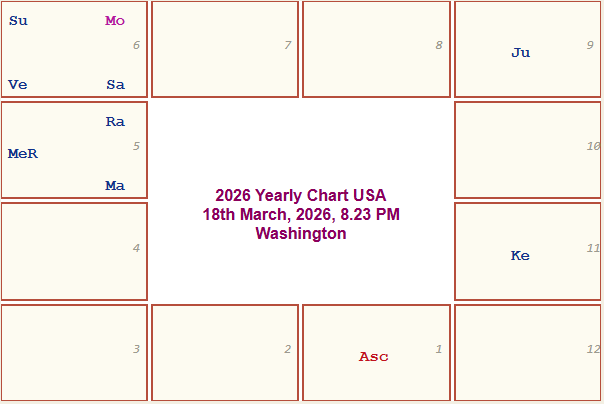
The astrological outlook for the United States in 2026 suggests a year of continued strain in foreign relations, with diplomacy challenged by shifting alliances, trade pressures, and security concerns. International engagement is likely to remain complex, requiring careful recalibration rather than rapid resolution. Domestically, industries linked to entertainment, leisure, and amusement may face a period of slowdown, driven by economic caution, evolving consumer behaviour, and structural adjustments within these sectors. From a security and economic perspective, April and August 2026 emerge as sensitive periods, with an elevated risk of terror-related threats or security disruptions, underscoring the need for heightened vigilance. Meanwhile, the technology and communication sectors may experience notable disruption, as rapid AI adoption and speculative investment raise the possibility of a technology-driven market correction or bubble. Overall, 2026 appears to be a year of reassessment for the United States, testing resilience across diplomacy, security, and innovation.
Russia Forecast – 2026
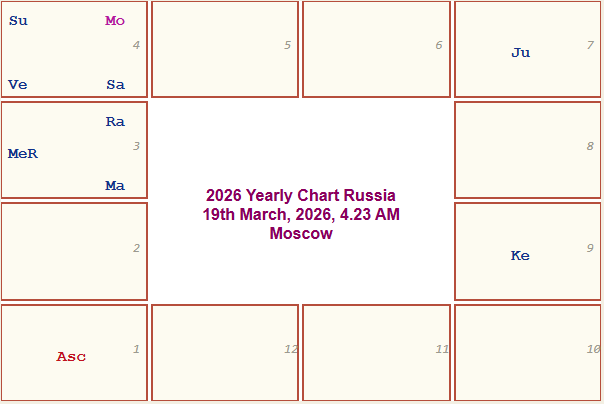
The astrological indicators for Russia in 2026 suggest a year marked by heightened internal security concerns and external pressures. April and August 2026 emerge as sensitive periods, with an elevated risk of terror-related incidents, particularly involving religious or symbolic locations, alongside the possibility of aerial or cross-border military actions intensifying regional tensions. Domestically, restrictions on freedom of speech and communication may become more pronounced, reflecting tighter controls over information and public discourse. On the environmental front, the year indicates overall healthy rainfall, though localised flash flooding, especially around April 2026, could pose short-term challenges in vulnerable regions.
Ukraine Forecast – 2026
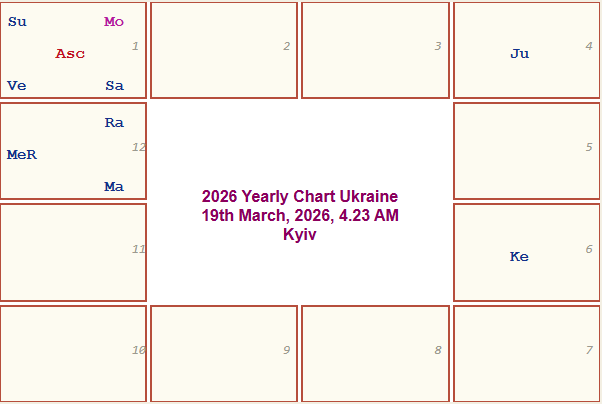
The astrological outlook for Ukraine in 2026 points to continued security challenges, with April 2026 emerging as a particularly sensitive period. War-related tensions are likely to persist, including the possibility of aerial and naval military actions linked to neighboring regions, sustaining an atmosphere of geopolitical uncertainty. Despite these pressures, the year offers a more constructive signal for the agricultural sector, with exports showing signs of recovery, providing partial economic relief to farmers and rural communities. At the same time, the chart raises concerns about covert activities and hidden criminal plots, particularly within institutional environments such as hospitals, highlighting the need for heightened oversight, transparency, and internal security.
UK & Europe Forecast – 2026
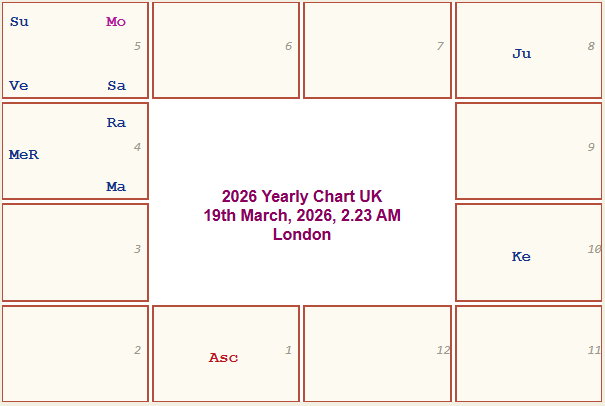
The astrological indicators for the UK and Europe in 2026 suggest a period of economic and social strain, particularly affecting trade and agriculture, as supply-chain disruptions, policy adjustments, and environmental factors place pressure on these sectors. Security concerns remain elevated, with a heightened risk of terror-related incidents, including the possibility of ideologically or religiously motivated attacks on educational institutions, underscoring the need for strengthened preventive measures. Socially, the year may witness organized movements or radicalized groups challenging legal authority, leading to episodes of civil unrest and confrontations with law enforcement, as public dissatisfaction
China Forecast – 2026
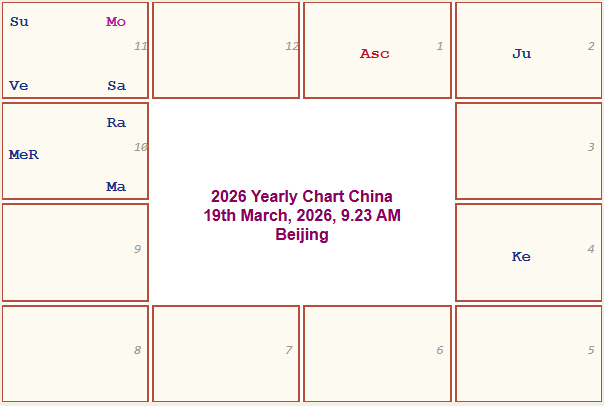
The astrological outlook for China in 2026 indicates a year of internal realignment and external economic pressure. The chart points to the possibility of communal or ideological unrest, suggesting heightened sensitivity around social cohesion and governance. Economically, imports and exports are likely to face notable disruption, reflecting shifts in global trade dynamics, regulatory pressures, and geopolitical recalibration. As a result, national growth and revenue may experience fluctuations, with periods of expansion followed by correction rather than sustained momentum. On the environmental front, the indicators highlight a risk of a high-intensity earthquake around April 2026, calling for preparedness and infrastructural resilience in vulnerable regions.
Japan Forecast – 2026
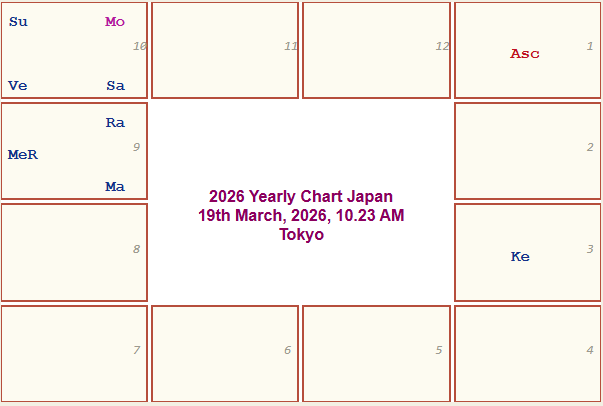
The astrological indicators for Japan in 2026 suggest a year of institutional adjustment and heightened public sensitivity. The chart points to legal changes and significant amendments, reflecting efforts to adapt governance frameworks to evolving social and economic conditions. At the same time, there is an elevated concern regarding the safety of prominent spiritual or religious figures, warranting increased protective and security measures. Environmentally, April 2026 emerges as a critical period, with a heightened risk of a high-intensity earthquake, underscoring the need for disaster preparedness. Additionally, the year may witness widespread health-related challenges, placing pressure on public health systems and necessitating proactive preventive responses.
Israel & Middle East Forecast – 2026
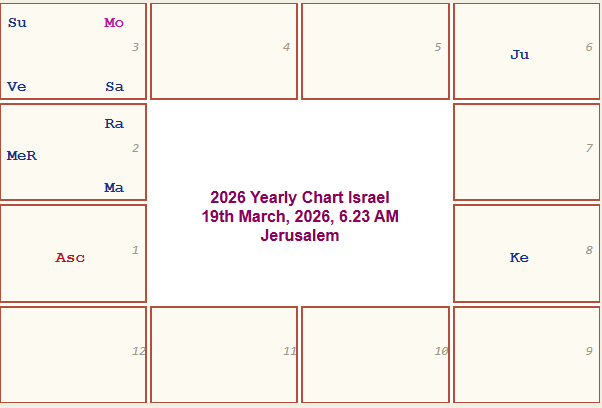
The astrological outlook for Israel and the Middle East in 2026 points to a year of heightened volatility and regional sensitivity. April 2026 stands out as a particularly critical period, with an elevated risk of communal unrest and terror-related incidents, alongside a greater likelihood of aerial security challenges involving neighboring states. Economically, imports and exports are expected to face significant disruption, reflecting ongoing geopolitical tensions and shifting trade dynamics. Environmental indicators further suggest an increased risk of high-intensity earthquakes and localized flash flooding, particularly during the middle part of the year, emphasizing the need for preparedness across both security and disaster-management fronts.
Australia Forecast – 2026
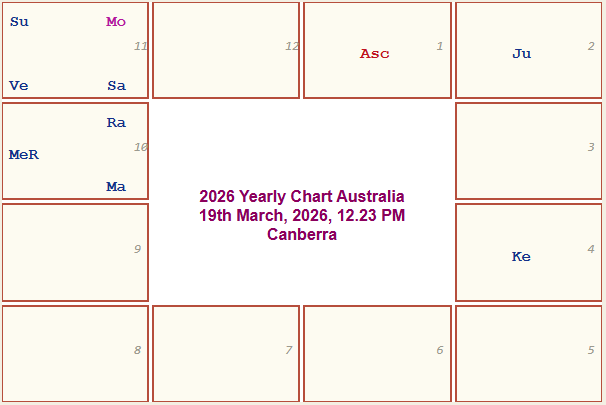
The astrological indicators for Australia in 2026 suggest a year of internal civic expression alongside external stability. The chart points to the likelihood of public protests or movements challenging legal or policy frameworks, reflecting heightened civic engagement and demands for reform. At the same time, foreign trade is well supported, with international commerce contributing positively to economic performance, supported by generally stable and cooperative global relationships. Despite this outward stability, April 2026 emerges as a sensitive period, with an increased risk of localized flash flooding and isolated security concerns, underscoring the importance of preparedness and vigilance.
Indonesia Forecast – 2026
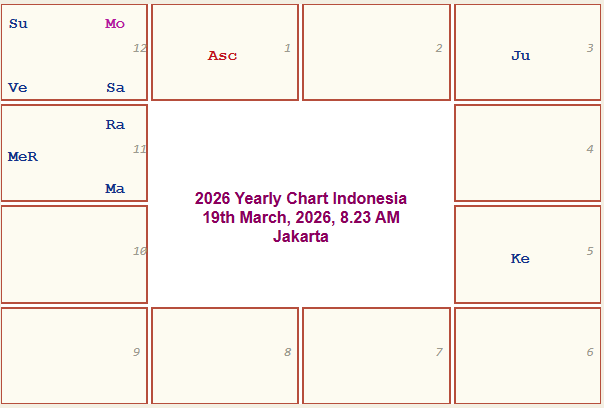
The astrological outlook for Indonesia in 2026 highlights a year requiring heightened vigilance across environmental, health, and security domains. April 2026 emerges as a particularly sensitive period, with indicators pointing to a high-intensity earthquake and potential tsunami alerts, underscoring the importance of disaster preparedness and early-warning systems. Public health may also come under strain, with an increased likelihood of widespread viral or influenza-related illnesses affecting the general population. From a geopolitical perspective, the chart suggests intermittent border-related security concerns, while economically, imports and exports are likely to remain profitable, albeit dependent on careful negotiations and strategic trade management.
Singapore & Malaysia Forecast – 2026
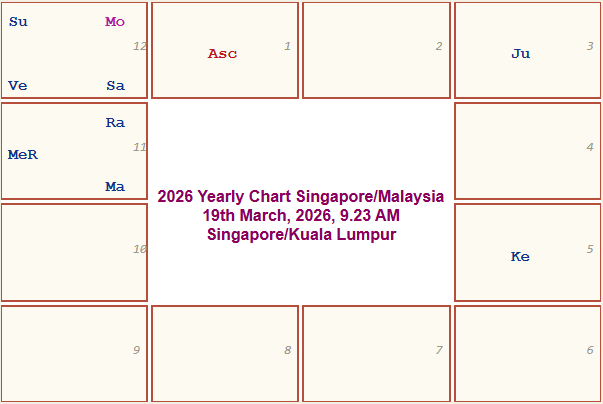
The astrological indicators for Singapore and Malaysia in 2026 point to a year of measured economic and social pressure. Public health may require heightened attention, with signs of widespread illness affecting segments of the population. April 2026 emerges as a sensitive period, carrying a heightened risk of seismic activity, necessitating preparedness despite the region’s generally lower historical exposure. Economically, growth is likely to remain subdued, accompanied by a cooling job market and the possibility of large-scale workforce adjustments or layoffs, particularly in sectors undergoing structural or technological change.
Pakistan & Afghanistan Forecast – 2026
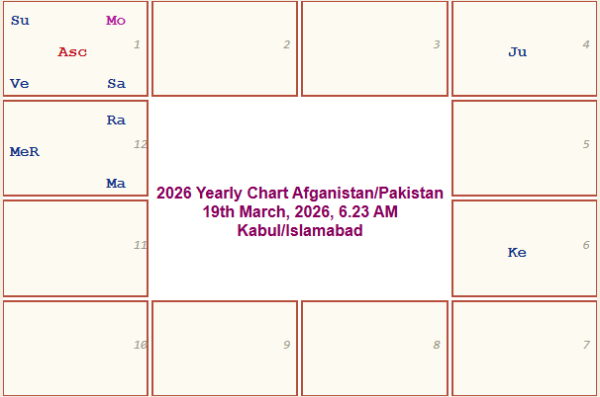
The astrological outlook for Pakistan and Afghanistan in 2026 indicates a year of heightened geopolitical strain and internal security challenges. War-related tensions with neighboring nations are likely to persist, accompanied by a further deterioration in regional diplomatic relationships, limiting prospects for stability or cooperation. The chart also highlights an increased risk of terror-related incidents, particularly involving religious or symbolic locations, underscoring ongoing security vulnerabilities. Environmentally, April 2026 emerges as a critical period, with indicators pointing to flash flooding and the possibility of high-intensity earthquakes, emphasizing the need for preparedness across both humanitarian and disaster-response systems.
Conclusion 2026: A Year of Transition, Tension, and Transformation
The astrological landscape of 2026 reflects a world navigating heightened geopolitical sensitivities, rapid technological evolution, environmental volatility, and shifting socio-economic structures. From persistent war tensions and diplomatic recalibration to climate-related extremes and transformative advances in artificial intelligence, the year underscores a collective phase of reassessment and adaptation rather than linear growth. Several regions emerge as particularly sensitive during key periods—most notably April 2026—calling for greater preparedness, strategic foresight, and institutional resilience across nations.At the same time, 2026 also carries constructive undercurrents: agricultural recovery in select regions, renewed trade opportunities through negotiation, and the potential for long-term structural reform driven by technological innovation. The recurring theme across geographies is the need for balanced governance, ethical leadership, and proactive crisis management in an increasingly interconnected world.
Disclaimer Note
These observations are based on principles of Vedic mundane astrology and are intended to provide symbolic and trend-based insights into global patterns and sensitivities rather than deterministic or absolute forecasts. The purpose of this analysis is to encourage awareness, preparedness, and informed reflection, not to predict unavoidable outcomes.